Journal of International College of Dentists
Journal of International College of Dentists (JICD) is an open-access, peer-reviewed, Quarterly journal publishing under the auspices of the International College of Dentists. As soon as the Article is accepted for Publication, it will be placed in “Ahead of Print” on the journal page with the aim of rapid and better knowledge dissemination. In addition, the journal allows free access (Open Access) to its contents, which is likely to attract more readers and citations to articles published in journal. Manuscripts must be prepared under the “Uniform requirements” of the ...
Comparison of patient and orthodontist interpretation of the aesthetic component of the index of orthodontic treatment need
Abstract
Introduction: Dental aesthetics play a crucial role in motivating individuals to seek orthodontic treatment. Perception of dental appearance often differs between patients and orthodontists, which may influence treatment expectations, compliance, and satisfaction. With the aim to compare patient and orthodontist assessment of dental aesthetics using the Aesthetic Component (AC) of the Index of Orthodontic Treatment Need (IOTN), and to evaluate the influence of gender on aesthetic treatment need perception.
Materials and Methods: A prospective cross-sectional study was conducted among 70 participants (35 males and 35 females) aged 10–16 years attending the OPD at the National Dental College and Hospital. Standardized intraoral frontal photographs were obtained and assessed independently by participants and the orthodontist using the AC of IOTN. Statistical analysis was performed using Chi-square and Mann–Whitney U tests with significance set at p < 0.05.
Results: A statistically non-significant difference was found between the orthodontist’s rating and participants self-assessment overall (p = 0.318). No statistically significant gender-based differences were observed.
Conclusion: Patients tend to perceive their dental aesthetics more favourably than orthodontists. Self-perception should be considered alongside professional assessment to improve communication and treatment planning.
1. Introduction
Concern for dental appearance is one of the primary reasons individuals seek orthodontic treatment. However, perceptions of acceptable dental aesthetics vary considerably between individuals. What may appear aesthetically acceptable to one person may be considered unattractive by another.[1]
An acceptable dental appearance significantly contributes to self-esteem, confidence, and psychosocial well-being. Malocclusion and irregular dental alignment may adversely affect an individual’s perception of facial attractiveness and social acceptance.[2]
The majority of occlusal indices determine aesthetics and ultimately, the necessity for orthodontic treatment solely from the perspective of the doctor (normative need), ignoring the social requirements of the patients. However, as patients are the ones undergoing treatment and must be satisfied with better aesthetics, their perspective of dental aesthetics cannot be undervalued.[3][4]
To standardize evaluation, objective indices such as the Index of Orthodontic Treatment Need (IOTN), developed by Brook and Shaw in 1989, are widely used to assess orthodontic treatment necessity. The Aesthetic Component (AC) of IOTN specifically evaluates visible dental attractiveness using a 10-point photographic scale, where Score 1 represents the most attractive and Score 10 the least attractive dental appearance.[2]
Previous studies have reported patients views on orthodontic treatment need based on dental and facial appearance, which may differ from the treatment need as determined by clinicians.[5]
There is a need to explore the differences in how patients and orthodontists interpret the aesthetic component of the Index of Orthodontic Treatment Need (IOTN). Understanding these variations is crucial for aligning treatment recommendations with patient expectations, improving communication, and ensuring that orthodontic care is both clinically effective and aesthetically satisfying.
The aim of this study was to compare the assessment of dental aesthetics using the Aesthetic Component (AC) of the Index of Orthodontic Treatment Need (IOTN) between patients and orthodontist. Also, to compare the aesthetic treatment need among the males and females.
2. Materials and Methods
This prospective cross-sectional study included 70 participants (35 females and 35 males) aged 10–16 years, with a mean age of 15.02 years, seeking orthodontic treatment at the Department of Orthodontics and Dentofacial Orthopaedics at National Dental College and Hospital, Derabassi, Punjab. The subjects were selected based on the pre-defined inclusion criteria which included, subjects aged 10–16 years, no previous orthodontic treatment history. Subjects with cleft lip and/or palate, hormonal imbalance or any systemic diseases were excluded from the study.
All the 70 participants intraoral frontal photographs were assessed by the participants themselves and the orthodontist (having minimum 2 years of clinical experience) independently using the AC scale of IOTN ([Figure 1]) with grade 1 being the most attractive dentition and grade 10 being the least attractive dentition. The following are the AC grades that match the numbers on the corresponding photos, indicating the various levels of treatment need: AC Grades 1–4: No need for orthodontic treatment. AC Grade 5–7: Borderline / Moderate need for orthodontic treatment. AC Grade 8–10: Definite need for orthodontic treatment.[2]
![AC Scale of IOTN.[6]](https://iptypeset.com/article_images/10-18231-j-jicd-18900-1785129059/img_rId6.jpeg)
2.1. Methodology
Step 1: Standardized frontal intraoral photographs were taken in occlusion.([Figure 2])
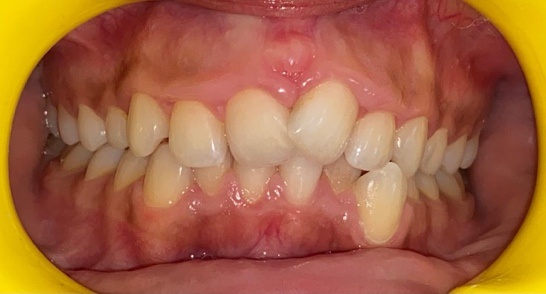
Step 2: The participant was shown the AC scale along with his/her own photograph and was asked to select the AC image that best matched their dental appearance.
Step 3: The orthodontist independently evaluated the same photograph using the IOTN-AC scale.
Step 4: Scores were recorded and tabulated for statistical analysis.
2.2. Statistical Analysis
Data were entered into Microsoft Excel 2007 and analysed using SPSS version 23.0. Descriptive statistics included frequency and percentage distributions. Chi-square test was used for ordinal and nominal variable comparisons, while Mann–Whitney U test was used for intergroup comparisons. Statistical significance was established at a p-value of < 0.05.
3. Results
Among the female participants, the distribution of scores demonstrated some variation between laypersons and orthodontists; however, the difference was not statistically significant (p = 0.283). Laypersons most commonly assigned Score 1 (40.0%), followed by Score 3 (17.1%) and Score 4 (11.4%) ([Table 1]). In comparison, orthodontist’s rating showed a relatively more uniform distribution across the scoring categories, with Score 1 accounting for 25.7%, Scores 2 and 4 each comprising 17.1%, and Scores 6, 7, and 8 each represented by 8.6%. Lower proportions were observed among laypersons in the mid-range categories, particularly Score 2 (2.9%) and Score 5 (5.7%), whereas orthodontists reported comparatively higher frequencies within these scores. Nevertheless, the absence of statistical significance suggests that the overall scoring patterns between the two groups among female participants were largely comparable.
Among the male participants, the distribution of scores between laypersons and orthodontists exhibited some variation; however, the overall difference was not statistically significant (p = 0.713). Laypersons most frequently assigned Score 1 (31.4%) and Score 4 (28.6%), followed by Scores 3 and 7, each accounting for 8.6% ([Table 2]). In contrast, orthodontist’s rating demonstrated a more evenly distributed pattern across the score categories, with Score 4 being the most common (28.6%), followed by Scores 2, 3, and 8, each at 11.4%. Both groups showed similar proportions for Scores 5 and 10 (5.7%), whereas lower frequencies were noted for Scores 6 and 7 among orthodontists. Although minor differences were observed, such as a greater proportion of Score 1 ratings by laypersons and relatively higher mid-range scores assigned by orthodontists, the non-significant p-value suggests that the overall scoring patterns between the two groups among male participants were comparable.
|
GP |
1 n (%) |
2 n (%) |
3 n (%) |
4 n (%) |
5 n (%) |
6 n (%) |
7 n (%) |
8 n (%) |
9 n (%) |
10 n (%) |
P-value |
|---|---|---|---|---|---|---|---|---|---|---|---|
|
Layperson |
14 (40) |
1 (2.9) |
6 (17.1) |
4 (11.4) |
2 (5.7) |
3 (8.6) |
1 (2.9) |
3 (8.6) |
0 (0) |
1 (2.9) |
0.283 (NS) |
|
Orthodontist |
9 (25.7) |
6 (17.1) |
3 (8.6) |
6 (17.1) |
1 (2.9) |
4 (11.4) |
3 (8.6) |
3 (8.6) |
0 (0) |
0 (0.0) |
|
|
Chi Square test with p value more than 0.05 is non-significant. |
|||||||||||
|
GP |
1 n (%) |
2 n (%) |
3 n (%) |
4 n (%) |
5 n (%) |
6 n (%) |
7 n (%) |
8 n (%) |
9 n (%) |
10 n (%) |
P-value |
|---|---|---|---|---|---|---|---|---|---|---|---|
|
Layperson |
11 (31.4) |
1 (2.9) |
3 (8.6) |
10 (28.6) |
2 (5.7) |
1 (2.9) |
3 (8.6) |
2 (5.7) |
0 (0.0) |
2 (5.7) |
0.713 (NS) |
|
Orthodontist |
6 (17.1) |
4 (11.4) |
4 (11.4) |
10 (28.6) |
2 (5.7) |
2 (5.7) |
1 (2.9) |
4 (11.4) |
0 (0.0) |
2 (5.7) |
|
|
Chi Square test with p value more than 0.05 is non-significant. |
|||||||||||
|
GP |
1n (%) |
2 n (%) |
3 n (%) |
4 n (%) |
5 n (%) |
6 n (%) |
7 n (%) |
8 n (%) |
9 n (%) |
10 n (%) |
P-value |
|---|---|---|---|---|---|---|---|---|---|---|---|
|
Layperson |
25 (35.7) |
2 (2.9) |
9 (12.9) |
14 (20) |
4 (5.7) |
4 (5.7) |
4 (5.7) |
5 (7.1) |
0 (0) |
3 (4.3) |
0. 3 18 (Non- Sig) |
|
Orthodontist |
15 (21.4) |
10 (14.3) |
7 (10) |
16 (22.9) |
3 (4.3) |
6 (8.6) |
4 (5.7) |
7 (10.0) |
0 (0) |
2 (2.9) |
|
|
Chi Square test with p value more than 0.05 is non-significant. |
|||||||||||
|
Gender |
GP |
Group Description |
Mean |
SD |
Standard Error (SE) |
P-value |
|---|---|---|---|---|---|---|
|
Female |
Layperson |
Laypersons |
3.40 |
2.60 |
0.44 |
0. 3 45 (Non- Sig) |
|
Orthodontist |
Orthodontists |
3.66 |
2.40 |
0.41 |
||
|
Male |
Layperson |
Laypersons |
3.86 |
2.67 |
0.45 |
0. 212 (Non- Sig) |
|
Orthodontist |
Orthodontists |
4.20 |
2.59 |
0.44 |
||
|
Mann Whitney U test with p value more than 0.05 is non-significant. |
||||||
[Table 3] illustrates a comparison of scoring patterns between laypersons (n = 70) and orthodontists (n = 70), which revealed variations across the different score categories; however, the overall difference was not statistically significant (p = 0.318). Laypersons most frequently assigned Score 1 (35.7%), followed by Score 4 (20.0%) and Score 3 (12.9%). In contrast, orthodontists demonstrated a relatively more balanced distribution, with Score 4 being the most commonly assigned (22.9%), followed by Score 1 (21.4%) and Score 2 (14.3%). Lower frequencies were observed among laypersons in the mid-range categories, particularly Score 2 (2.9%) and Score 5 (5.7%), whereas orthodontists reported comparatively higher proportions for Score 2 (14.3%), Score 6 (8.6%), and Score 8 (10.0%). Despite these observable differences in distribution, statistical analysis showed no significant association between professional group and score allocation, indicating that the overall rating patterns of laypersons and orthodontists were broadly comparable.
[Table 4] represents the mean scores for female participants were 3.40 ± 2.60 for laypersons and 3.66 ± 2.40 for orthodontists, with no statistically significant difference between the groups (p = 0.345). Similarly, among male participants, the mean scores were 3.86 ± 2.67 for laypersons and 4.20 ± 2.59 for orthodontists, and the difference was also found to be statistically non-significant (p = 0.212). Overall, orthodontists demonstrated slightly higher mean scores than laypersons in both genders; however, these differences were not statistically significant.
4. Discussion
Dental aesthetics is one of the most important factors influencing the demand for orthodontic treatment, particularly among adolescents, in whom facial appearance and smile attractiveness have a significant psychosocial impact. The present study was undertaken to compare the perception of dental aesthetics between patients and orthodontists using the Aesthetic Component of the Index of Orthodontic Treatment Need (IOTN-AC), and to evaluate whether gender influences this perception.[7]
The findings of the present study demonstrated that although laypersons tended to assign slightly lower AC scores than orthodontists, the overall difference between the two groups was statistically non-significant (p = 0.318) ([Table 3]). This suggests a broadly comparable perception of dental aesthetics between patients and clinicians in the studied population. These findings are in accordance with the study by Siddiqui et al., who reported a significant positive correlation and fair agreement between patient self-perception and orthodontist assessment using the IOTN-AC, although patients were less accurate in identifying the severity of malocclusion compared with clinicians.[8]
In the present study, laypersons most frequently selected lower scores, particularly Score 1, indicating that patients generally perceived their dental appearance more favourably than orthodontists. This tendency has been consistently reported in previous literature, where patients often underestimate the severity of malocclusion when compared with professional evaluation. Abdullah and Rock similarly observed that self-perception of dental aesthetics may differ from professional judgment, with patients frequently considering their appearance more acceptable than clinicians do.[9] Such differences may be attributed to the fact that orthodontists are trained to identify minor irregularities in alignment, spacing, crowding, and occlusal discrepancies that may not be readily apparent or concerning to patients. Cai et al. also demonstrated that young adults were less critical in their aesthetic self-assessment than orthodontists, with only a modest level of agreement between the two groups.[10] This discrepancy may be attributed to the orthodontist’s professional training, which enables identification of minor crowding, spacing, rotations, and occlusal discrepancies that may not be apparent to the patient.
Gender-wise analysis in the present study also revealed no major clinically relevant difference in perception patterns between males and females. Although females showed slightly lower mean scores compared with males in both layperson and orthodontist groups, the overall scoring trends remained similar. This observation is supported by the study conducted in Eastern Nepalese patients, where gender was found to have no statistically significant influence on self-perception or orthodontist assessment.[11] However, females are often considered to have greater aesthetic awareness and may be more sensitive to dental appearance, which may explain the minor differences observed.
An important observation from this study was that orthodontists demonstrated a more balanced distribution across score categories, whereas laypersons predominantly clustered their ratings in lower score ranges. This suggests that orthodontists tend to distribute cases more objectively according to the severity spectrum defined by the IOTN-AC scale. Similar findings have been reported by Kapoor and Singh, who emphasized the usefulness of the AC-IOTN as a reliable clinical tool for treatment prioritization, patient counselling, and treatment planning.[12]
The absence of statistically significant differences between groups may also suggest that the Aesthetic Component is a useful communication tool for bridging the gap between professional assessment and patient expectations. Since orthodontic treatment outcomes are closely linked to patient satisfaction, incorporating self-perceived aesthetic concerns into treatment planning can enhance compliance, motivation, and overall acceptance of treatment recommendations. Previous studies have highlighted that discrepancies between patient expectations and clinician assessment may influence treatment acceptance and satisfaction.[8][10]
From a clinical perspective, these findings underscore the importance of incorporating patient self-perception into orthodontic treatment planning. Since orthodontic treatment is often sought for aesthetic reasons, understanding the patient’s subjective concerns is essential for establishing realistic expectations, improving communication, and enhancing treatment satisfaction. Previous studies have emphasized that treatment decisions based solely on normative assessment may overlook the psychosocial needs of the patient.[13] Therefore, combining clinician-based indices with patient-reported perceptions can facilitate a more patient-centered approach to care.
The present study has certain limitations. The sample size was relatively small and restricted to a single institution-based adolescent population, which may limit the generalizability of the findings. In addition, only the aesthetic component of IOTN was assessed, whereas inclusion of the Dental Health Component (DHC) could have provided a more comprehensive evaluation of treatment need. Future studies with larger multicentric samples and combined use of AC and DHC components are recommended.
Overall, the findings of the present study reinforce the importance of considering both clinician assessment and patient self-perception while evaluating orthodontic treatment need, especially in aesthetically driven cases.
5. Conclusion
Within the limitations of this study, the Aesthetic Component of the Index of Orthodontic Treatment Need demonstrated a generally comparable pattern of interpretation between patients/laypersons and orthodontists, with no statistically significant overall difference. Nevertheless, patients tended to perceive their dental aesthetics more favourably than orthodontists, often assigning lower scores and thereby underestimating the severity of malocclusion. This disparity highlights the subjective nature of aesthetic self-perception and underscores the need to integrate patient-reported concerns with objective clinical assessment. A combined consideration of both normative and self-perceived treatment need may facilitate more effective communication, improve treatment acceptance and compliance, and contribute to a more patient-centered approach in orthodontic treatment planning and outcome satisfaction.
6. Authors Contributions
Ruchika Batra: Data curation, investigation, methodology, resources, writing – original draft, Vinay Dua: Conceptualization, data curation, investigation, project administration, supervision, writing – review editing, Harvinder Singh: Investigation, project administration, resources, supervision, Yenika Manchanda: Data curation, methodology, project administration, supervision, Aman Jot Kaur: Conceptualization, investigation, visualization, writing – original draft.
7. Source of Funding
None.
8. Conflict of Interest
None.
References
- Hamdan AM. The relationship between patient, parent and clinician perceived need and normative orthodontic treatment need. Eur J Orthod. 2004;26(3):265-71. [Google Scholar] [Crossref]
- Aikins EA, Dacosta OO, Onyeaso CO, Isiekwe MC. Self-Perception of Malocclusion Among Nigerian Adolescents Using The Aesthetic Component of The IOTN. Open Dent J. 2012;6:61-6. [Google Scholar] [Crossref]
- Hunt O, Hepper P, Johnston C, Stevenson M, Burden D. The Aesthetic Component of the Index of Orthodontic Treatment Need validated against lay opinion. Eur J Orthod. 2002;24(1):53-9. [Google Scholar] [Crossref]
- Grzywacz I. The value of the aesthetic component of the Index of Orthodontic Treatment Need in the assessment of subjective orthodontic treatment need. Eur J Orthod. 2003;25(1):57-63. [Google Scholar] [Crossref]
- Shue-Te Yeh M, Koochek AR, Vlaskalic V, Boyd R, Richmond S. The relationship of 2 professional occlusal indexes with patients' perceptions of aesthetics, function, speech, and orthodontic treatment need. Am J Orthod Dentofacial Orthop. 2000;118(4):421-8. [Google Scholar] [Crossref]
- Evans R, Shaw W. Preliminary evaluation of an illustrated scale for rating dental attractiveness. Eur J Orthod. 1987;9(4):314-8. [Google Scholar] [Crossref]
- Bahar AD, Sagi MS, Mohd Zuhairi FA, Wan Hassan WN. Dental Aesthetics and Self-Esteem of Patients Seeking Orthodontic Treatment. Healthcare (Basel). 2024;12(16):1576. [Google Scholar] [Crossref]
- Siddiqui TA, Shaikh A, Fida M. Agreement between orthodontist and patient perception using Index of Orthodontic Treatment Need. Saudi Dent J. 2014;26(4):156-65. [Google Scholar] [Crossref]
- Abdullah MS, Rock WP. Perception of dental appearance using Index of Treatment Need (Aesthetic Component) assessments. Community Dent Health. 2002;19(3):161-5. [Google Scholar]
- Cai Y, Du W, Lin F, Ye S, Ye Y. Agreement of young adults and orthodontists on dental aesthetics & influencing factors of self-perceived aesthetics. BMC Oral Health. 2018;18(1):113. [Google Scholar] [Crossref]
- Singh VP, Sharma A, Roy DK. Assessment of the self-perception of dental appearance, its comparison with orthodontist’s assessment and demand for treatment in Eastern Nepalese patients. Int J Dent. 2014:174932. Int J Dent. 2014. [Google Scholar] [Crossref]
- Kapoor P, Singh H. Evaluation of esthetic component of the index of orthodontic treatment need: The orthodontists' perspective. Indian J Dent. 2015;6(4):181-4. [Google Scholar] [Crossref]
- Vedovello SAS, Dos Santos PR MDCA, Vedovello Filho M, Ambrosano GMB, Pereira AC. Exploring the perception of orthodontic treatment need using the Dental Aesthetic Index and Index of Orthodontic Treatment Need. Am J Orthod Dentofacial Orthop. 2019;156(6):818-22. [Google Scholar] [Crossref]
Article Metrics
- Visibility 321 Views
- Downloads 338 Views
- DOI 10.18231/j.jicd.18900.1785129059
-
CrossMark

- Citation
- Received Date May 28, 2026
- Accepted Date July 02, 2026
- Publication Date July 27, 2026