Journal of International College of Dentists
Journal of International College of Dentists (JICD) is an open-access, peer-reviewed, Quarterly journal publishing under the auspices of the International College of Dentists. As soon as the Article is accepted for Publication, it will be placed in “Ahead of Print” on the journal page with the aim of rapid and better knowledge dissemination. In addition, the journal allows free access (Open Access) to its contents, which is likely to attract more readers and citations to articles published in journal. Manuscripts must be prepared under the “Uniform requirements” of the ...
A questionnaire based survey to assess the hygiene habits and attitudes among removable partial denture wearers
Abstract
Background: Removable partial dentures require regular and appropriate hygiene maintenance to prevent plaque accumulation, mucosal irritation, halitosis, caries, and periodontal deterioration. Patient-related factors, professional instructions, and denture-wearing habits may influence the quality of denture-care practices.
Materials and Methods: This cross-sectional questionnaire-based study included 384 removable partial denture wearers attending a prosthodontic outpatient department. Data were collected regarding demographic characteristics, duration and daily use of removable partial dentures, cleaning frequency, cleaning methods, overnight wear, use of denture-cleansing tablets, perceived oral-health problems, attitudes toward denture hygiene, and sources of denture-care information. Denture hygiene practice was categorized as adequate or inadequate based on predefined behavior-related criteria. Associations were assessed using the chi-square test, and independent predictors of adequate hygiene practice were evaluated using multivariable logistic regression.
Results: Adequate denture hygiene practice was observed in 164 participants, while 220 participants demonstrated inadequate hygiene behavior. Most participants perceived denture cleaning as important for oral health; however, only 102 participants cleaned their denture after every meal, and 149 reported overnight denture wear. Brushing was the most commonly reported cleaning method, whereas denture-cleansing tablet use was reported by 74 participants. Receipt of post-insertion instructions, higher education level, and use of denture-cleansing tablets were significantly associated with adequate hygiene practice. Longer duration of denture use and prolonged daily wearing time were associated with inadequate hygiene behavior.
Conclusion: Less than half of the removable partial denture wearers demonstrated adequate hygiene practices despite favorable attitudes toward denture care. Post-insertion instructions and reinforced patient education may play an important role in improving denture-care behavior.
1. Introduction
Removable Partial Dentures (RPDs) remain a widely used treatment option for partially edentulous patients because they are relatively affordable, conservative, repairable, and suitable for replacing multiple missing teeth in different clinical situations.[1] They are particularly relevant in patients for whom fixed prostheses or implant-supported options may not be feasible because of anatomical, financial, systemic, or treatment-planning limitations.[2] However, unlike fixed prostheses, RPDs are repeatedly inserted, removed, handled, and exposed to the oral environment, making their hygiene maintenance highly dependent on patient behaviour.[3] Inadequate denture hygiene may contribute to plaque accumulation on the prosthesis and remaining teeth,[4] while RPD-related plaque retention has also been associated with caries and periodontal changes around abutment and non-abutment teeth.[5] Poor prosthesis maintenance may further contribute to halitosis, mucosal inflammation, and denture-related stomatitis, particularly when dentures are worn continuously or overnight.[6][7]
Previous studies have shown that denture hygiene practices are often inconsistent among removable denture wearers. Milward et al. reported important deficiencies in the knowledge of RPD wearers regarding denture hygiene, suggesting that many patients do not fully understand recommended cleaning measures.[8] Peracini et al. also observed that denture wearers frequently relied on routine brushing practices, but their overall hygiene behavior did not consistently match recommended standards.[9] Kulak-Ozkan et al. found that poor denture cleanliness, yeast colonization, and denture stomatitis may coexist among elderly denture wearers.[10] Evidence from denture-care guidelines indicates that regular mechanical cleaning should be supported by appropriate chemical cleansing and removal of the prosthesis during sleep.[11] Patient attitude is also important, as Cinquanta et al. reported that self-reported hygiene habits do not always correspond with clinically acceptable prosthesis cleanliness.[12] Recent multicenter evidence has further emphasized that removable complete and partial denture wearers may depend on different sources of information, and dentist-delivered instructions remain an important component of prosthesis maintenance.[13]
Despite the available literature, several gaps remain. Many studies have evaluated complete denture wearers, elderly institutionalized individuals, or mixed removable-prosthesis groups, while fewer have focused specifically on RPD wearers.[14] Moreover, limited data are available regarding the relationship between hygiene habits, attitudes, professional instructions, sources of information, and demographic factors in Indian dental institutional settings. Understanding these factors is clinically relevant because RPD wearers retain natural teeth that may be vulnerable to plaque-related disease if prosthesis hygiene is neglected.[5]
Therefore, this study aimed to assess hygiene habits, cleaning practices, knowledge, and attitudes among RPD wearers. The specific objectives were to evaluate the frequency and methods of denture cleaning, assess attitudes toward denture hygiene, identify perceived oral-health problems related to poor cleaning, and determine the association of socio-demographic and prosthesis-related factors with denture hygiene practices.
2. Materials and Methods
The present cross-sectional, questionnaire-based survey was conducted in the Department of Prosthodontics, in a dental institution in the city of Mumbai, over a period of three months from January 2026 to March 2026. The study was conducted after institutional approval (Reference Letter Number). Participation was voluntary, and informed consent was obtained from all participants before data collection. Participants were assured that refusal to participate or withdrawal from the study would not affect their treatment. Confidentiality was maintained by anonymizing questionnaire responses and using the data only for research purposes.
The sample size was calculated using a single-proportion formula, considering an expected prevalence of inadequate hygiene practices of 52%, 95% confidence level, and 5% absolute precision. The minimum required sample size was estimated to be 384 participants. A convenience sampling method was used, and eligible RPD wearers attending the department during the study period were invited to participate until the required sample size was achieved.
2.1. Study population and eligibility criteria
Participants included individuals aged 18 years and above who had been wearing a removable partial denture for at least 6 months and were able to understand the questionnaire in the language provided. Patients wearing RPDs for less than 6 months, individuals below 18 years of age, and those unwilling to participate or provide consent were excluded from the study. Participants who submitted incomplete or inconsistent responses were excluded from the final analysis to maintain data quality.
2.2. Questionnaire and study variables
Data were collected using a structured questionnaire developed to assess demographic characteristics, RPD-related factors, hygiene practices, knowledge, attitudes, and sources of denture-care information. The questionnaire included items on age, gender, duration of RPD use, daily wearing time, receipt of post-insertion instructions, frequency of denture cleaning, cleaning methods, brush type, materials used for brushing and soaking, overnight denture wear, difficulty in cleaning, use of denture-cleansing tablets, perceived oral-health problems, willingness to improve hygiene practices, and sources of information. Most questions were closed-ended and included multiple-choice, yes/no, and frequency-based responses. The questionnaire was available in English and translated versions to improve participant comprehension.
2.3. Data collection procedure
Eligible participants were approached during their visit to the prosthodontic outpatient department. The purpose of the study was explained, and written informed consent was obtained before questionnaire administration. Participants completed the questionnaire independently; assistance was provided only when clarification of a question was required, without influencing the response. Completed questionnaires were checked for completeness before data entry. Responses were coded and entered into a Microsoft Excel spreadsheet, and the final dataset was verified for missing entries, duplicate records, and inconsistent responses before statistical analysis.
2.4. Outcome measures
The primary outcome was the pattern of hygiene practices among RPD wearers. For analytical purposes, denture hygiene practice was classified as adequate or inadequate based on selected behavior-related responses. Participants were considered to have adequate hygiene practice when they reported cleaning the RPD at least once daily or after every meal, using a mechanical cleaning method such as brushing, and avoiding overnight denture wear. Participants not fulfilling these criteria were categorized as having inadequate hygiene practice. Secondary outcomes included knowledge regarding the importance of RPD cleaning, perceived oral-health problems related to poor denture hygiene, willingness to modify hygiene behavior, and the association of demographic and prosthesis-related variables with hygiene practices.
2.5. Statistical analysis
Data were analyzed using statistical software after coding and verification. Categorical variables were summarized as frequencies and percentages. Continuous variables, where applicable, were expressed as mean and standard deviation. The chi-square test was used to evaluate associations between hygiene-practice categories and independent variables such as age group, gender, education level, duration of RPD use, daily wearing time, receipt of dentist instructions, and overnight denture wear, consistent with the planned analysis described in the protocol. Variables showing meaningful association in bivariate analysis were considered for binary logistic regression to identify independent predictors of adequate denture hygiene practice. A p-value of less than 0.05 was considered statistically significant.
3. Results
A total of 384 removable partial denture wearers were included in the analysis. The largest age groups were 51–60 years and ≥61 years, together accounting for more than half of the sample. Most participants had been using their removable partial denture for more than 1 year, and 270 participants reported wearing the prosthesis for at least 8 hours per day. The demographic and prosthesis-related characteristics are summarized in Table 1.
|
Variable |
Category |
n (%) |
|---|---|---|
|
Age group |
21–30 years |
34 (8.9) |
|
31–40 years |
58 (15.1) |
|
|
41–50 years |
83 (21.6) |
|
|
51–60 years |
104 (27.1) |
|
|
≥61 years |
105 (27.3) |
|
|
Gender |
Male |
203 (52.9) |
|
Female |
181 (47.1) |
|
|
Education level |
Up to primary school |
73 (19.0) |
|
Secondary school |
129 (33.6) |
|
|
Graduate |
124 (32.3) |
|
|
Postgraduate |
58 (15.1) |
|
|
Duration of RPD use |
6 months–1 year |
92 (24.0) |
|
1–2 years |
121 (31.5) |
|
|
>2 years |
171 (44.5) |
|
|
Daily duration of RPD wear |
<4 hours |
32 (8.3) |
|
4–8 hours |
82 (21.4) |
|
|
8–12 hours |
121 (31.5) |
|
|
>12 hours |
96 (25.0) |
|
|
Full time |
53 (13.8) |
|
Variable |
Category |
n (%) |
|---|---|---|
|
Post-insertion instructions received |
Yes |
229 (59.6) |
|
No |
155 (40.4) |
|
|
Frequency of RPD cleaning |
After every meal |
102 (26.6) |
|
Once daily |
214 (55.7) |
|
|
Once weekly |
47 (12.2) |
|
|
Rarely |
21 (5.5) |
|
|
Cleaning method used |
Brushing |
336 (87.5) |
|
Soaking |
154 (40.1) |
|
|
Both brushing and soaking |
126 (32.8) |
|
|
Other methods |
22 (5.7) |
|
|
Type of brush used |
Toothbrush |
271 (70.6) |
|
Denture-cleaning brush |
82 (21.4) |
|
|
Hand/finger |
22 (5.7) |
|
|
Other |
9 (2.3) |
|
|
Material used for brushing |
Toothpaste |
214 (63.7) |
|
Water only |
68 (20.2) |
|
|
Soap |
37 (11.0) |
|
|
Baking soda |
12 (3.6) |
|
|
Detergent |
5 (1.5) |
|
|
Material used for soaking |
Denture-cleansing tablet |
59 (38.3) |
|
Sodium hypochlorite |
38 (24.7) |
|
|
Soap |
23 (14.9) |
|
|
Baking soda |
18 (11.7) |
|
|
Other |
16 (10.4) |
|
|
Soaking in water when not in use |
Yes |
148 (38.5) |
|
Sometimes |
96 (25.0) |
|
|
No |
140 (36.5) |
|
|
Overnight denture wear |
Yes |
149 (38.8) |
|
No |
235 (61.2) |
|
|
Difficulty in cleaning RPD |
Yes |
134 (34.9) |
|
No |
250 (65.1) |
|
|
Most difficult area to clean |
Clasp assembly |
63 (47.0) |
|
Denture base/intaglio surface |
37 (27.6) |
|
|
Acrylic teeth |
23 (17.2) |
|
|
Polished surface |
11 (8.2) |
|
|
Use of denture-cleansing tablet |
Yes |
74 (19.3) |
|
No |
310 (80.7) |
|
|
Frequency of tablet use |
Once daily |
61 (82.4) |
|
More than once daily |
13 (17.6) |
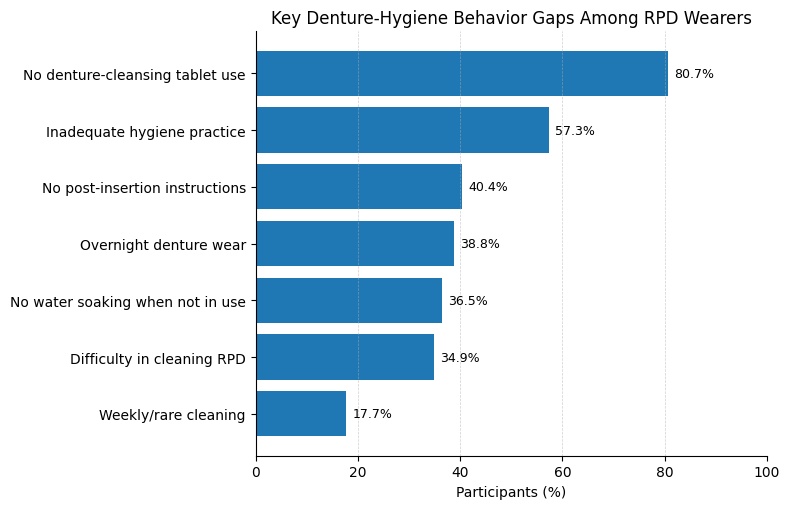
Regarding denture-care practices, 229 participants reported receiving post-insertion maintenance instructions from their dentist. Cleaning once daily was the most common practice, whereas only 102 participants cleaned their RPD after every meal. Brushing was the most frequently reported cleaning method, while denture-cleansing tablet use was reported by 74 participants. Overnight denture wear was reported by 149 participants. Detailed hygiene practices are presented in Table 2. The major hygiene-related behavior gaps reported among removable partial denture wearers are depicted in Figure 1.
Most participants perceived RPD cleaning as important for oral health. However, 148 participants reported at least one oral-health problem that they associated with irregular denture cleaning, most commonly gum irritation or infection, bad breath, and plaque accumulation or tooth decay. A high proportion of participants expressed willingness to modify their hygiene practices if advised by a dental professional. Knowledge, attitudes, perceived oral-health issues, and sources of information are shown in Table 3.
Based on the predefined criteria, 164 participants were categorized as having adequate denture hygiene practice, while 220 were categorized as having inadequate practice. Adequate hygiene practice showed statistically significant associations with age group, education level, duration of RPD use, daily duration of wear, receipt of post-insertion instructions, use of denture-cleansing tablets, and difficulty in cleaning the denture. No significant association was observed with gender. These associations are presented in Table 4.
|
Variable |
Category |
n (%) |
|---|---|---|
|
Perceived RPD cleaning as important for oral health |
Yes |
358 (93.2) |
|
No |
26 (6.8) |
|
|
Oral-health issues attributed to irregular RPD cleaning |
Gum irritation/infection |
62 (16.1) |
|
Bad breath |
49 (12.8) |
|
|
Tooth decay/plaque accumulation |
37 (9.6) |
|
|
No issue experienced |
181 (47.1) |
|
|
Not sure |
55 (14.3) |
|
|
Willingness to improve cleaning habits if advised |
Yes, definitely |
247 (64.3) |
|
Yes, possibly |
105 (27.3) |
|
|
No, satisfied with current habits |
24 (6.3) |
|
|
No, would not change |
8 (2.1) |
|
|
Main source of denture-cleaning information |
Dentist |
219 (57.0) |
|
Internet |
66 (17.2) |
|
|
Pharmacy |
42 (10.9) |
|
|
Friend/neighbour |
38 (9.9) |
|
|
Television |
19 (4.9) |
|
Variable |
Category |
Adequate hygiene n (%) |
Inadequate hygiene n (%) |
p-value |
|---|---|---|---|---|
|
Age group |
21–30 years |
22 (64.7) |
12 (35.3) |
<0.001 |
|
31–40 years |
32 (55.2) |
26 (44.8) |
||
|
41–50 years |
39 (47.0) |
44 (53.0) |
||
|
51–60 years |
42 (40.4) |
62 (59.6) |
||
|
≥61 years |
29 (27.6) |
76 (72.4) |
||
|
Gender |
Male |
85 (41.9) |
118 (58.1) |
0.804 |
|
Female |
79 (43.6) |
102 (56.4) |
||
|
Education level |
Up to primary school |
20 (27.4) |
53 (72.6) |
<0.001 |
|
Secondary school |
48 (37.2) |
81 (62.8) |
||
|
Graduate |
61 (49.2) |
63 (50.8) |
||
|
Postgraduate |
35 (60.3) |
23 (39.7) |
||
|
Duration of RPD use |
6 months–1 year |
54 (58.7) |
38 (41.3) |
<0.001 |
|
1–2 years |
58 (47.9) |
63 (52.1) |
||
|
>2 years |
52 (30.4) |
119 (69.6) |
||
|
Daily duration of RPD wear |
<4 hours |
19 (59.4) |
13 (40.6) |
<0.001 |
|
4–8 hours |
47 (57.3) |
35 (42.7) |
||
|
8–12 hours |
52 (43.0) |
69 (57.0) |
||
|
>12 hours |
34 (35.4) |
62 (64.6) |
||
|
Full time |
12 (22.6) |
41 (77.4) |
||
|
Post-insertion instructions received |
Yes |
124 (54.1) |
105 (45.9) |
<0.001 |
|
No |
40 (25.8) |
115 (74.2) |
||
|
Use of denture-cleansing tablet |
Yes |
50 (67.6) |
24 (32.4) |
<0.001 |
|
No |
114 (36.8) |
196 (63.2) |
||
|
Difficulty in cleaning RPD |
Yes |
40 (29.9) |
94 (70.1) |
<0.001 |
|
No |
124 (49.6) |
126 (50.4) |
|
Predictor |
Adjusted OR |
95% CI |
p-value |
|---|---|---|---|
|
Age ≥61 years |
0.74 |
0.42–1.31 |
0.301 |
|
Female gender |
1.08 |
0.70–1.66 |
0.728 |
|
Graduate/postgraduate education |
1.89 |
1.20–2.98 |
0.006 |
|
RPD use >2 years |
0.55 |
0.35–0.87 |
0.011 |
|
Daily RPD wear >12 hours/full time |
0.61 |
0.39–0.96 |
0.034 |
|
Post-insertion instructions received |
2.72 |
1.73–4.28 |
<0.001 |
|
Use of denture-cleansing tablet |
2.11 |
1.22–3.65 |
0.008 |
|
Difficulty in cleaning RPD |
0.68 |
0.43–1.09 |
0.108 |
In multivariable logistic regression analysis, receipt of post-insertion instructions, higher education level, and use of denture-cleansing tablets were independently associated with greater odds of adequate denture hygiene practice. RPD use for more than 2 years and full-time denture wear were associated with lower odds of adequate hygiene practice. Age and gender were not statistically significant independent predictors in the final model. The regression analysis is shown in Table 5.
4. Discussion
The present study showed that hygiene practices among Removable Partial Denture (RPD) wearers were inconsistent, despite generally favorable attitudes toward denture care. Although most participants recognized that RPD cleaning was important for oral health, less than half fulfilled the criteria for adequate hygiene practice. This gap between knowledge and actual behavior is clinically relevant because RPDs remain in close contact with oral tissues and remaining natural teeth, allowing plaque, food debris, and microorganisms to accumulate if cleaning is inadequate.[3][5] Similar discrepancies between awareness and routine denture-care behavior have been reported among removable prosthesis wearers, suggesting that patient knowledge does not always translate into effective daily practice.[15][16] The finding suggests that awareness alone may not be sufficient to produce appropriate hygiene behavior; repeated instruction, demonstration, and reinforcement during follow-up visits may be necessary.[11][17]
Cleaning once daily was the most common practice, while only about one-fourth of participants cleaned their RPD after every meal. Brushing was the predominant cleaning method, whereas chemical cleansing methods and denture-cleansing tablets were used by a smaller proportion of participants. This pattern is comparable to earlier studies that reported brushing as the most commonly used method among denture wearers.[9][18] Dikbas et al. found that brushing with toothpaste was common, but only a small proportion of patients had clean dentures, indicating that the method used may not always be effective when performed incorrectly or without adjunctive chemical cleansing.[18] Similarly, Papadiochou and Polyzois concluded that combined mechanical and chemical hygiene measures are generally more effective than either approach alone, although many patients do not follow such recommendations consistently.[19] Clinical evidence also indicates that denture cleaning method and overnight storage conditions can influence denture biofilm mass and composition.[20]
A notable finding was the strong association between receipt of post-insertion instructions and adequate hygiene practice. Participants who had received professional instructions were more likely to report better cleaning behavior. This supports the role of the dentist not only in prosthesis fabrication but also in long-term maintenance of prosthetic and oral health.[11][13] Ribeiro et al. demonstrated that oral hygiene education and motivation can improve plaque and gingival outcomes among RPD wearers over follow-up, which aligns with the present finding that instruction is a modifiable factor influencing hygiene behaviour.[17] The persistence of inadequate hygiene among uninstructed patients may reflect insufficient chairside communication, lack of written instructions, or poor patient recall after denture delivery.[8][21]
Overnight denture wear and prolonged daily use were also associated with poorer hygiene practice. Continuous wearing may reduce opportunities for cleaning and tissue rest, while also increasing plaque retention on denture surfaces.[6][10] Recent evidence has similarly highlighted poor denture-care habits, irregular dental visits, and continuous denture use as common concerns among removable prosthesis wearers.[12][13] Denture wearing during sleep has also been associated with adverse oral and systemic outcomes in elderly populations, further supporting the need to discourage unnecessary overnight wear.[22] The lower likelihood of adequate hygiene among long-term RPD users may indicate that motivation declines over time, especially when follow-up visits are complaint-driven rather than preventive.[23]
Education level also emerged as an important determinant, with higher education being associated with better hygiene practice. This may be due to better comprehension of instructions, greater health literacy, and improved access to oral-health information. Basnyat et al. similarly reported that prosthesis cleanliness was influenced by age and education level, and emphasized the need for improved patient awareness.[24] Studies among elderly and removable denture-wearing populations have also shown that hygiene status may vary according to patient-related factors, including education, dependency, and access to professional advice.[21][23] However, the high willingness to improve among participants in the present study is encouraging, suggesting that structured counseling may be well accepted.
This study has certain limitations. Being a single-center, questionnaire-based survey, the findings may not be generalizable to all RPD wearers. Self-reported responses may be affected by recall bias and social desirability bias, and clinical assessment of denture plaque, mucosal status, caries, or periodontal health was not performed. The cross-sectional design also prevents causal interpretation of associations. Future studies should include multicenter samples, validated denture-cleanliness indices, and clinical oral-health parameters. Interventional studies evaluating the effect of chairside demonstration, written instructions, reminder-based reinforcement, and recall-based hygiene motivation would help determine effective strategies for improving long-term denture-care behavior among RPD wearers.
5. Conclusion
Less than half of the RPD wearers demonstrated adequate denture hygiene practices, although most participants recognized the importance of denture cleaning for oral health. Receipt of post-insertion instructions, higher education level, and use of denture-cleansing tablets were associated with better hygiene practices, while prolonged denture use and longer daily wearing duration were associated with inadequate hygiene behavior.
6. Source of Funding
None.
7. Conflict of Interest
None
References
- Carr AB, Brown DT. McCracken’s Removable Partial Prosthodontics. 13th ed. St Louis: Elsevier. 2015. [Google Scholar]
- Campbell SD, Cooper L, Craddock H, Hyde TP, Nattress B, Pavitt SH. Removable partial dentures: The clinical need for innovation. J Prosthet Dent. 2017;118(3):273-80. [Google Scholar] [Crossref]
- Preshaw PM, Walls AWG, Jakubovics NS, Moynihan PJ, Jepson NJA, Loewy Z. Association of removable partial denture use with oral and systemic health. J Dent. 2011;39(11):711-9. [Google Scholar] [Crossref]
- Addy M, Bates JF. Plaque accumulation following the wearing of different types of removable partial dentures. J Oral Rehabil. 1979;6(2):111-7. [Google Scholar] [Crossref]
- Zlataric DK, Celebic A, Valentic-Peruzovic M. The effect of removable partial dentures on periodontal health of abutment and non-abutment teeth. J Periodontol. 2002;73(2):137-44. [Google Scholar] [Crossref]
- Yeung AL, Lo EC, Chow TW, Clark RK. Oral health status of patients 5-6 years after placement of cobalt-chromium removable partial dentures. J Oral Rehabil. 2000;27(3):183-9. [Google Scholar] [Crossref]
- Budtz-Jørgensen E. Materials and methods for cleaning dentures. J Prosthet Dent. 1979;42(6):619-23. [Google Scholar] [Crossref]
- Milward P, Katechia D, Morgan MZ. Knowledge of removable partial denture wearers on denture hygiene. Br Dent J. 2013;215(10):E20. [Google Scholar] [Crossref]
- Peracini A, Andrade IM, Paranhos Hde F, Silva CH DSR. Behaviors and hygiene habits of complete denture wearers. Braz Dent J. 2010;21(3):247-52. [Google Scholar] [Crossref]
- Kulak-Ozkan Y, Kazazoglu E, Arikan A. Oral hygiene habits, denture cleanliness, presence of yeasts and stomatitis in elderly people. J Oral Rehabil. 2002;29(3):300-4. [Google Scholar] [Crossref]
- Felton D, Cooper L, Duqum I, Minsley G, Guckes A, Haug S, et al. Evidence-based guidelines for the care and maintenance of complete dentures: a publication of the American College of Prosthodontists. J Prosthodont. 2011;1:S1-S12. [Google Scholar] [Crossref]
- Cinquanta L, Varoni EM, Barbieri C, Sardella A. Patient attitude and habits regarding removable denture home hygiene and correlation with prosthesis cleanliness: A cross-sectional study of elderly Italians. J Prosthet Dent. 2021;125(5):772-772.e7. [Google Scholar] [Crossref]
- Algabri R, Alqutaibi AY, Altayyar S, Mohammed A, Khoshafa G, Alryashi E. Behaviors, hygiene habits, and sources of care among removable complete and partial dentures wearers: A multicenter cross-sectional study. Clin Exp Dent Res. 2024;10(2):e867. [Google Scholar] [Crossref]
- Shaha M, Varghese R, Atassi M. Understanding the impact of removable partial dentures on patients' lives and their attitudes to oral care. Br Dent J. 2021. [Google Scholar] [Crossref]
- Cakan U, Yuzbasioglu E, Kurt H, Kara HB TR, Akbulut A. Assessment of hygiene habits and attitudes among removable partial denture wearers in a university hospital. Niger J Clin Pract. 2015;18(4):511-5. [Google Scholar] [Crossref]
- de Castellucci Barbosa L, Ferreira MR DCCC, Viana AC DLM, Lauria RA. Edentulous patients' knowledge of dental hygiene and care of prostheses. Gerodontology. 2008;25(2):99-106. [Google Scholar] [Crossref]
- Ribeiro DG, Pavarina AC, Giampaolo ET, Machado AL, Jorge JH, Garcia PP. Effect of oral hygiene education and motivation on removable partial denture wearers: longitudinal study. Gerodontology. 2009. p. 150-6. [Google Scholar] [Crossref]
- Dikbas I, Koksal T, Calikkocaoglu S. Investigation of the cleanliness of dentures in a university hospital. Int J Prosthodont. 2006;19(3):294-8. [Google Scholar]
- Papadiochou S, Polyzois G. Hygiene practices in removable prosthodontics: A systematic review. Int J Dent Hyg. 2018;16(2):179-201. [Google Scholar] [Crossref]
- Duyck J, Vandamme K, Krausch-Hofmann S, Boon L, De Keersmaecker K, Jalon E. Impact of Denture Cleaning Method and Overnight Storage Condition on Denture Biofilm Mass and Composition: A Cross-Over Randomized Clinical Trial. PLoS One. 2016;11(1):e0145837. [Google Scholar] [Crossref]
- Hoad-Reddick G, Grant AA, Griffiths CS. Investigation into the cleanliness of dentures in an elderly population. J Prosthet Dent. 1990;64(1):48-52. [Google Scholar] [Crossref]
- Iinuma T, Arai Y, Abe Y, Takayama M, Fukumoto M, Fukui Y. Denture wearing during sleep doubles the risk of pneumonia in the very elderly. J Dent Res. 2015;94(3_suppl):28S-36S. [Google Scholar] [Crossref]
- Akar GC ES. The oral hygiene and denture status among residential home residents. Clin Oral Investig. 2008;12(1):61-5. [Google Scholar] [Crossref]
- Basnyat SK, Mahanta S, Sapkota B. Association between prosthesis cleanliness and patient’s knowledge on hygiene habits among complete denture patients and partial denture prostheses wearers. J Nepalese Prosthodont Soc. 2022;5(2):57-63. [Google Scholar] [Crossref]
Article Metrics
- Visibility 280 Views
- Downloads 333 Views
- DOI 10.18231/j.jicd.44002.1785132481
-
CrossMark

- Citation
- Received Date June 01, 2026
- Accepted Date July 10, 2026
- Publication Date July 27, 2026