Journal of International College of Dentists
Journal of International College of Dentists (JICD) is an open-access, peer-reviewed, Quarterly journal publishing under the auspices of the International College of Dentists. As soon as the Article is accepted for Publication, it will be placed in “Ahead of Print” on the journal page with the aim of rapid and better knowledge dissemination. In addition, the journal allows free access (Open Access) to its contents, which is likely to attract more readers and citations to articles published in journal. Manuscripts must be prepared under the “Uniform requirements” of the ...
Emendation of anterior torque using lower premolar brackets
Abstract
Orthodontic treatment mechanics are determined by bracket positioning and selection. The ability to determine which bracket is used at particular situation is determined by clinician thinking ability. We need to apply sound principle while changing the bracket in a particular tooth. Some cases need extra torque because of their placement in the arch. In this pearl we have broadened the versatility of the MBT brackets by placing lower premolar bracket on anterior (incisors and canine) for better torque correction without any wire bending.
1. Introduction
Individuals coming to dental practitioner per se orthodontist for getting themselves treated are mainly concerned with the “social six”, which forms the backbone for social communication and acceptance.[1] Orthodontic treatment aims to position anterior teeth to achieve optimum esthetics and function. The variations proposed by McLauglin, Bennett and Trevisi (MBT) aims to further improve results of the finished cases. One of the major strengths of the MBT technique resides in the ability to show versatility in many situations, allowing to change the position of a tooth or group of teeth without using additional brackets or incorporate bends in the arc in the final stages of treatment. The relevance of the proper bucco-lingual inclination of a tooth can be deciphered from the fact that its proper positioning in the arch is essential to provide better aesthetic, stability and occlusal relationship. The first and second generation of brackets and buccal tubes had a single option for each specific tooth, with a recommendation for proper tip, torque and in-out compensation. There was little room for versatility. The MBT bracket system has overall design improvements compared with previous appliances.[2] These include changes in tip and torque, as well as design features which introduce versatility. The innovation incorporates seven different bracket and buccal tube possibilities, depending on the needs of the case. This creates a platform for the arch wires and the bracket system to produce the necessary individualization and overcorrection for certain types of case. The benefit can apply to individual teeth or to groups of teeth, in some instances. This reduces the need for first-, second- and third-order bends later in treatment, and improves efficiency.[3] We have done modification using lower premolar brackets in the upper and lower anterior region for better torque correction.[4][5]
2. Discussion
The orthodontist is often called upon to correct upper incisors which are palatally placed which will require more labial root torque in this stage.[6][7] One option available in the MBT appliance is to invert the lateral incisor bracket by 180° to provide -10 of torque. But in certain situations, there will be need for additional wire bending which can lead to extended treatment time. A convenient way to manage these cases involves the use of excess premolar brackets which remains unused in out daily practice and be successfully utilised in these crowded cases for torque correction.[8]
During the alignment stage, it is necessary to create enough space for the malposed tooth. This is achieved by using Ni Ti open coil spring on stainless steel wire. The brackets on the adjacent teeth are tied with wire ligatures to prevent untoward tooth movement. It is necessary to create sufficient space for palatally placed incisor before attempting to move them in alignment. Bend backs are placed 2 mm distal to molar tubes, to allow an increase in arch length.
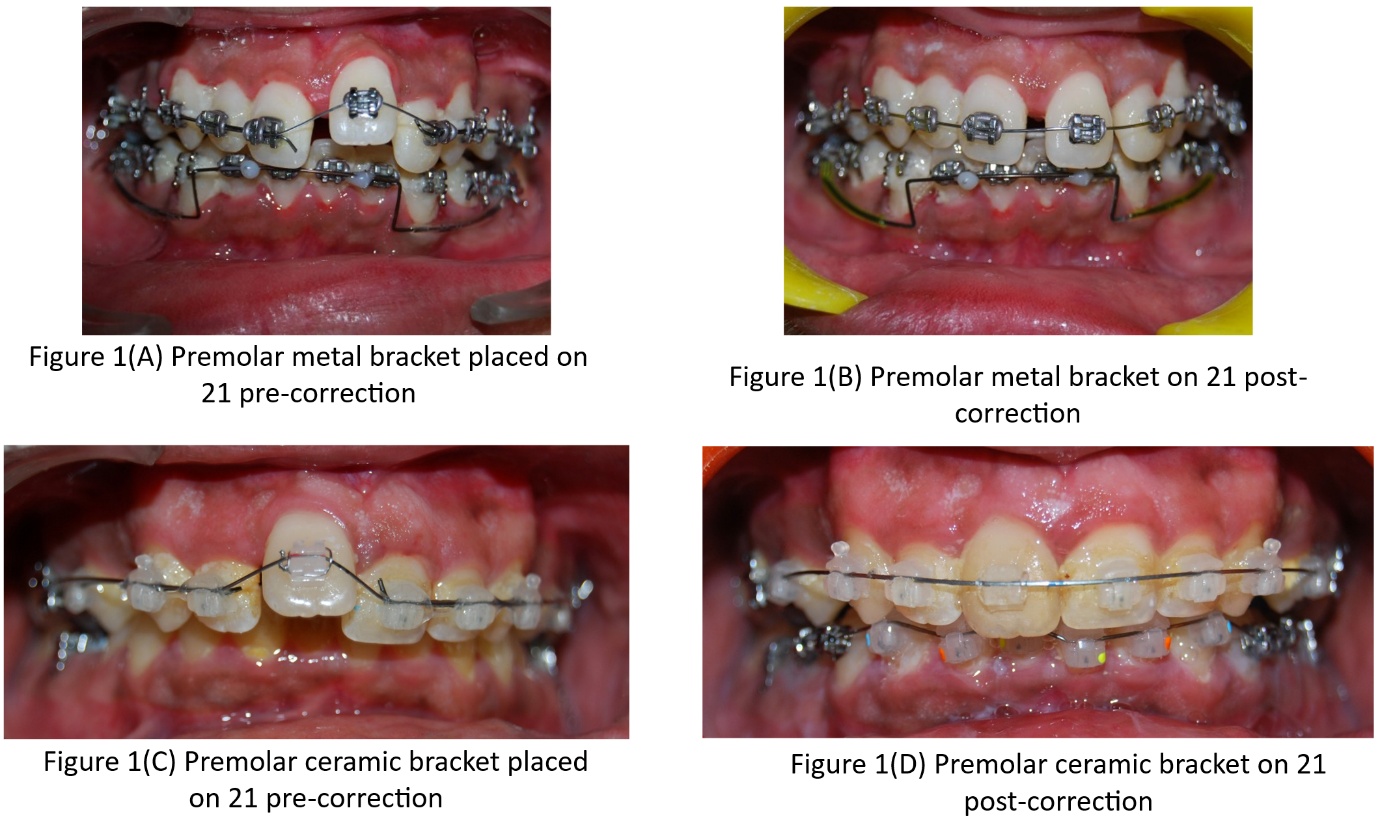
The palatally displaced incisor is bonded with the lower second premolar bracket of contralateral side for more labial root torque required in this condition, which changes the torque to -17°. A flipped mandibular second premolar bracket has the same palatal torque as the maxillary incisor bracket. This assists in labial root torque at the rectangular wire stage. The tip requirement was adjusted during bonding procedure by angulating the bracket slight mesially, compensating for the extra 6 degree of distal root tip. The left side second premolar bracket is placed on the right incisor and vice versa [Figure 1] (A) (B) (C) (D).
Lower premolar can also be used in lingually displaced canines and incisor. ([Figure 2])
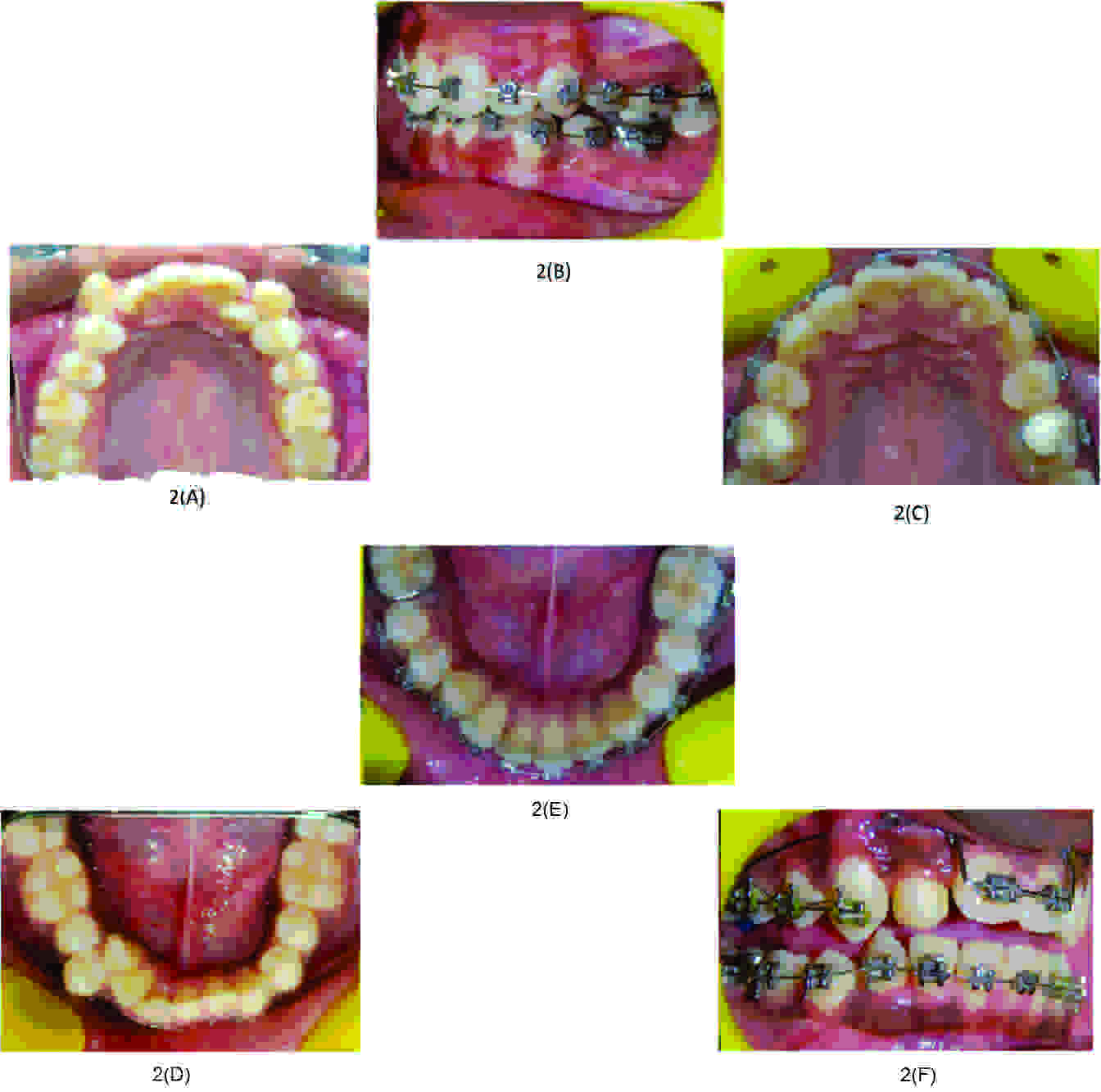
Torque option present in MBT prescription for the lower incisor is -6° and for canine +6°, 0° and -6°. Sometimes these are not sufficient, and we need to put extra torque in the wire. This labial torque requirement can easily be done by using first (-12°) or second premolar bracket (-17°). Hooks should be trimmed off, if it’s used on incisor to avoid any trauma to soft tissue.
The curved bracket surfaces of the maxillary and mandibular premolar require base adjusted using Bird Beak/169 Plier to flatten it out or enameloplasty can be done. The flipped bracket does require removal of their posts after binding.
2.1. Advantages
Optimal utilization of unused brackets: this technique makes effective use of unused premolar brackets readily available in routine orthodontic practice, thereby minimizing the need for additional armamentarium or speacialised attachments.
Efficient torque correction: the method provises precise and controlled torque correction without the need to invert brackets, ensuring biomechanical efficiency while preserving the original bracket prescription.
Elimination of the complex wire bending: by avoiding tedious and technique=sensitive wire bending, the procedure simplifies chairside workflow and reduces operator fatigue.
Reduced treatment time: Streamlining torque correction without additional appliance modifications contributes to faster clinical outcomes.
Cost-effective and clinician-friendly: the approach requires no extra inventory or expensive materials, making it economical and easily adaptable in routine clinical practice.
3. Conclusion
The clinical tip provided in this article is simple, efficient and effective method for the rectification of the torque correction in orthodontic treatment.by utilizing unused premolar brackets and eliminating the need for complex wire bending or bracket inversion, this technique enhances biomechanical control while significantly reducing chair side time and overall treatment duration. Its cost effectiveness, ease of application, and predictability make it a valuable addition to everyday orthodontic practice, prmoting improved clinical efficiency and patient outcomes.
4. Patient Consent
Not Applicable (NA)
5. Ethical Approval
Not Applicable (NA)
6. Source of Funding
None.
7. Conflict of Interest
None.
References
- Andrews LF. The six keys to normal occlusion. Am J Ortho. 1972;62(3):296-309. [Google Scholar] [Crossref]
- McLaughlin RP, Bennett JC, Trevisi H. Systemized Orthodontic Treatment Mechanics. Mosby, St Louis. [Google Scholar]
- Bowman SJ, Carano A. The Butterfly Bracket System. J Clin Orthod. 2004;38:274-87. [Google Scholar]
- Smith RN, Karmo M, Russell J, Brook AH. The variability of the curvature of the labial surface of the upper anterior teeth along the facial axis of the clinical crown. Arch Oral Biol. 2007;52(11):1037-42. [Google Scholar] [Crossref]
- Gioka C, Eliades T. Materials-induced variation in the torque expression of preadjusted appliances. Am J Orthod Dentofacial Orthop. 2004;125(3):323-8. [Google Scholar] [Crossref]
- Kravitz ND, Miller S, Prakash A, Eapen JC. Canine Bracket Guide for Substitution Cases. J Clin Orthod. 2017;51(8):450-3. [Google Scholar]
- Kravitz ND, Miller S. The Rules of Bracket Flipping and Switching. J Clin Orthod. 2019;53(9):518-20. [Google Scholar]
- Rauch DE. Torque and its application to orthodontics. Am J Orthod. 1959;45:817-30. [Google Scholar]
Article Metrics
- Visibility 359 Views
- Downloads 513 Views
- DOI 10.18231/j.jicd.57356.1785133458
-
CrossMark

- Citation
- Received Date January 07, 2026
- Accepted Date February 09, 2026
- Publication Date July 27, 2026